Afghanistan Map
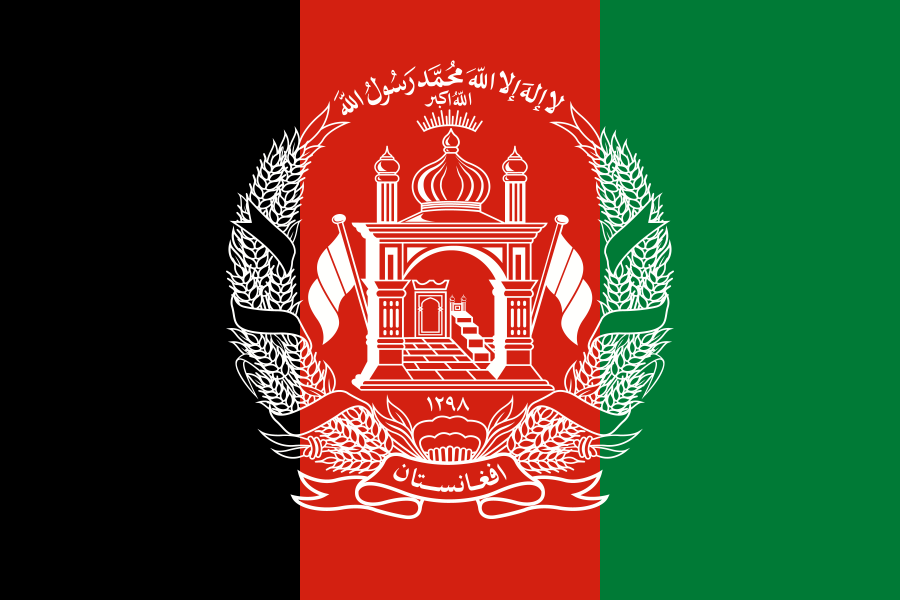
Capital: Kabul
Population: 43,844,111
Area: 652,864 km²
Currency: AFN
Languages: Dari, Pashto
Religions: Islam
Time zone: UTC+4:30
About Afghanistan
Afghanistan is a landlocked country located at the crossroads of Central and South Asia, bordered by Pakistan to the east and south, Iran to the west, Turkmenistan, Uzbekistan, and Tajikistan to the north, and China to the northeast. Covering approximately 652,864 square kilometers, Afghanistan is home to over 43 million people in a predominantly mountainous terrain. Its strategic location along ancient trade routes, including the historic Silk Road, has made it a cultural melting pot throughout history.
Afghanistan has a rich and complex history dating back thousands of years, with influences from Persian, Greek, Buddhist, and Islamic civilizations. The country is ethnically diverse, with major groups including Pashtuns, Tajiks, Hazaras, and Uzbeks, each with distinct languages and traditions. Dari and Pashto are the official languages, both written in Arabic script. Islam is the predominant religion, practiced by approximately 99% of the population. Afghan culture is known for its hospitality, traditional music, intricate carpets, and poetry, with renowned poets like Rumi having roots in the region.
Afghanistan's geography is dominated by the Hindu Kush mountain range, which extends through the central part of the country with peaks exceeding 7,000 meters. The terrain includes high plateaus, deep valleys, and deserts, with the Wakhan Corridor in the northeast connecting to China. The climate varies from arid to semi-arid, with cold winters and hot summers, and limited rainfall except in the mountain regions. Notable features include the Band-e-Amir National Park with its stunning blue lakes and the ancient Buddhas of Bamiyan valley.
Afghanistan's economy is primarily based on agriculture, with significant production of wheat, fruits, nuts, and historically opium poppies. The country possesses substantial mineral resources including copper, iron, and rare earth elements, though extraction has been limited. Kabul, the capital and largest city, is the political and economic center located in the eastern part of the country. Other major cities include Kandahar in the south, Herat in the west, and Mazar-i-Sharif in the north, each serving as regional hubs for trade and culture in this predominantly rural nation.
Major Cities
- Kabul - The capital and largest city with over 4.6 million people, serving as Afghanistan's political, economic, and cultural center
- Kandahar - The second-largest city and spiritual birthplace of the Taliban, located in southern Afghanistan with rich historical significance
- Herat - A major city in western Afghanistan near the Iranian border, known for its Persian influence and historical monuments
- Mazar-i-Sharif - Northern Afghanistan's largest city, famous for the Blue Mosque and its proximity to ancient Balkh
- Jalalabad - A major city in eastern Afghanistan known for its warmer climate and agricultural production
Interesting Facts
- Afghanistan is one of the world's oldest continuously inhabited regions, with archaeological evidence dating back over 50,000 years
- The country was once home to the famous Buddhas of Bamiyan, giant 6th-century statues carved into cliffs before their destruction in 2001
- Afghanistan has a unique time zone of UTC+4:30, one of only a few countries with a 30-minute offset
- The national sport is Buzkashi, a traditional game played on horseback where riders compete to grab a goat carcass
- Afghanistan is believed to possess over $1 trillion worth of untapped mineral deposits including lithium, copper, and rare earth elements
- The country produces some of the world's finest pomegranates, saffron, and grapes, with dried fruits being a major export